DID I SAY THAT? I PROMISED TO SUPPORT THE CHURCH BY MY WITNESS
Rev. Dr. Dennis Winkleblack
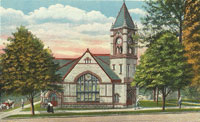
Prospect United Methodist Church
Bristol, Connecticut
January 31, 2010
Romans 12: 1-2
Galatians 2: 19-20
Matthew 5: 14-16
This morning I want to focus on the part of our membership vows that have us promising to support the ministry of the church by our “witness.” This is a new promise, added in 2008 by the General Conference of our church. It is in addition to our promise to support the ministry of the church by our prayers, presence, gifts and service.
What is General Conference? It’s a meeting of the United Methodist Church held every four years attended by persons (approximately 500 clergy and 500 laity) who have been elected as delegates from our world-wide denomination of 42,000 churches to make decisions about how we United Methodists are to live our life together. Once together in a week-long session, these delegates vote on issues pertaining to doctrine, to social issues and how we govern our churches.
As I mentioned, in 2008 the new promise of supporting the church by our witness was added. Why the change? By adding the word witness we do something the previous question and promises only hinted at: we promise to live a life in the world out there in such a way that others will see Christ in us and be drawn to Christ themselves. Someone has said that by adding the promise of witness we now promise not only to show up at church but to show forth to the world what the church and Jesus Christ are all about.
The bottom line question is: Do others see Jesus in you? If so, you’re being a good witness. If not, you’re not.
Another question that gets at the heart of the issue is, “If you were convicted of being a Christian, would there be enough evidence to convict you?”
Think about it. If being a Christian were suddenly against the law and you were brought to trial for being a Christian, would a good prosecuting attorney be able to come up with enough evidence to convict you before an impartial judge?
To get us started thinking in this vein, I now call upon our Prospect Players.
The setting is a Grand Jury called to determine if there is enough evidence to convict Tom Phillips, played by Terry Parker, of being a Christian.
The prosecuting attorney is played by Jeannette Baker. The defense attorney is played by Tim Krauss. The judge is played by Janice Moore.
-------------------------------------------------------------------
Prosecuting attorney: Your honor, I present Tom Phillips, and intend to show that there is enough evidence to convict him of being a Christian. For one, he is a member of a Christian church, Prospect United Methodist Church.
Defense Attorney: Your honor, going to church, holding church membership means nothing because millions and millions of people in the United States are members of churches.
Prosecutor: But Tom is not just a member. He actually goes to church regularly.
Defense Attorney: But your honor, just because a person goes inside a church doesn’t make them a Christian any more than going inside a garage makes them a car.
Prosecutor: Your honor, I know for a fact that Tom gives money to this church, lots of money.
Defense Attorney: But, your honor, please, lots of people give money for lots of reasons.
Judge: True, but giving money, especially lots of it, to a church is a point in the favor of the prosecution. This person may just be a Christian.
Prosecutor: In addition, your honor, I will present evidence to show that on a recent Saturday, Tom gave up his morning to go to this church and clean toilets.
Defense Attorney: This proves nothing, your honor. I think he just went there for the doughnuts.
Prosecutor: But, your honor, he goes there every week plus Wednesday night choir practices. Plus he’s on a church committee and gives up many hours a month for that.
Judge: A point in favor of the prosecution.
Prosecutor: Plus, another point: This person gives of his time to work with the Special Olympics, with persons with mental retardation. Plus, he made a lot of his friends upset because he is opposed to capital punishment and wrote a letter to the editor.
Judge: I see.
Prosecutor: A final point. I will present evidence that he cares that others see Christ in him. He’s careful about his drinking habits, how he spends his money, the kind of entertainment he enjoys… Once he even apologized when he cussed in front of someone.
Judge: I’m afraid it’s not looking good for you, Mr. Defense Attorney.
Defense Attorney: But, Judge ….
Judge: My judgment, Mr. Tom Phillips, is that there is obviously enough evidence to present you before a jury for trial and conviction as a Christian. By the way you have lived your life you have witnessed that you take Jesus Christ seriously. May God have mercy on your soul.
-------------------------------------------------------------------
So, what about it? What about you? Is it obvious that you’re a Christian? If you were convicted, would there be enough evidence to convict you? If so, then you are fulfilling your promise to be loyal to Christ and his church by your witness. This is what the hymn we sang, “This Little Light of Mine,” is all about.
Being a good witness for Jesus Christ involves both what might be called little things and big things. First little things.
Little things -- like the language we use. I can tolerate a certain level of street talk bad language, but not a lot. Although cussing isn’t a sin, per se, the use of foul language is offensive to most ears and something that surely doesn’t make God proud. So a Christian really does need to care about the language one uses.
And about the jokes one tells or laughs at. I have to confess that when I hear someone tell a joke that puts down someone of another race, I want to rage. Would Jesus do that? If not, then why would we?
Drinking habits. Spending habits. Anything and everything we do needs to glorify God. If it does, we’re being a good witness. If it doesn’t, we’re not.
There are, of course, bigger issues to be concerned about when we think about our witness in the world for Jesus Christ. Bigger things like the kind of work we do for living. Would we own a business or take employment in a business that harms other people? Each of us has to answer this for ourselves. We’re wise not to try to judge others. But at the least we should be able to justify before God that what we do is not harmful to others. Others should not have to wonder if we are a Christian because what we do for a living would seem to suggest otherwise.
Some of us can do specific good through our employment as clergy or a school teacher or as part of the medical profession or as a social worker or the like. Others don’t have this obvious advantage. However, if what a person does in offering a good or a service benefits society in some way, then one’s Christian witness is not being compromised in the least. In fact, you are part and parcel of making life good for others. And that is being a good witness.
In addition, as the drama underscored, for all of us there are multiple opportunities to do volunteer service that does directly express the love of God through compassion or mercy or education, and the like. Become known as one who gives time generously and you will be making a good witness.
In sum, being a good witness for Christ is about caring how others think about you. Fatal words, for Christians, are “I don’t care what anyone thinks about what I do.”
I began this series of sermons with the story told by Tony Campolo offering to give a birthday party for a prostitute at 3am in a diner in Hawaii. When asked by the diner’s owner what kind of church would give a birthday party for a prostitute at 3 in the morning, Campolo replied that his church does.
My point then and my point now is that Campolo’s church and our church are unique institutions. The church is not like any other club or group we might belong to. We are designed to be counter-cultural. Designed to be different in values and different in conduct and different in ideals than any other institution of which you may be part.
Accordingly, by extension as members of such a church, we, too, are called to be different, unique. Jesus said we’re to be the “salt” of the earth, the “leaven” in society and, of course, the light on a hill. Our DNA is to be different from the way the world works out there. To have higher values and higher expectations of ourselves and each other.
As the martyr, Dietrich Bonhoeffer, wrote: “Christ bids a person to come to him, and die.” Die to our merely mortal nature. To leave behind old values, old ways.
St. Paul put what happens to a person who becomes a Christian like this: “I have been crucified in Christ,” he wrote. “It is no longer I who live, but it is Christ who lives in me. And the life I now live in the flesh I live by faith in the Son of God, who loved me and gave himself for me.”
Will you repeat this after me? “It is no longer I who live. But it is Christ who lives in me. And the life I now live in the flesh, I live by faith in the Son of God, who loved me and gave himself for me.”
It is no longer I, Dennis, who live. But Christ who lives in me expressing himself through my unique, peculiar identity. At least on my better days. At least this is the way I want my life to be.
To promise to be loyal to Christ and church by our witness in the world is to remember that we are not our own. We have been bought with a price. And our lives should show it. And when are lives do show it, we are witnessing to our faith, and God will bless it.
To say the least, there should be more than enough evidence to convict us should we be charged with being a Christian.